
Podcast: Play in new window | Download (63.0MB)
Subscribe: Apple Podcasts | Spotify | Amazon Music | Podcast Index | RSS
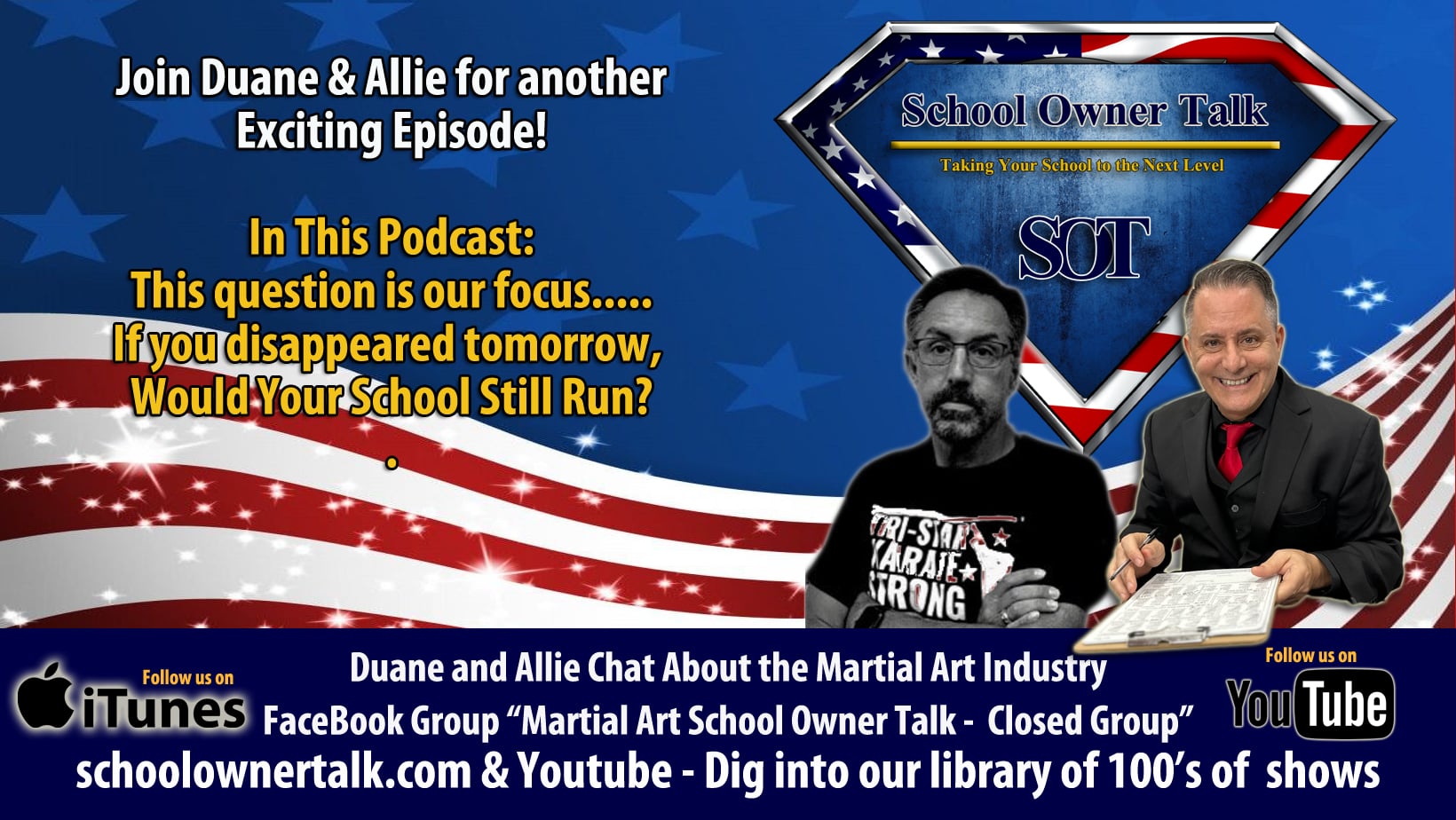
Episode 462: If You Disappeared Tomorrow, Would Your School Still Run?
Podcast Description
What happens to your martial arts school if you’re suddenly not there?
Not “I’m taking a planned vacation” not there. Not “I’ll still answer texts between classes” not there.
We mean: you’re out. Unexpected. Surgery. Family emergency. Injury. Something you didn’t schedule.
In this episode, Duane and Allie dig into a real-life gut check (literally): Duane ended up in the hospital for eight days after an emergency appendix surgery and complications.
And here’s the part that matters for school owners: the schools didn’t collapse.
Classes ran. Testing happened. Buddy Week kept moving. Parent communication stayed steady.
Not because Duane “powered through” from a hospital bed… but because the team, systems, and culture were already built to operate without the owner being the single point of failure.
Key Takeaways
- Ask the uncomfortable question: “What stops if I stop?”Duane frames it plainly: identify the responsibilities where you are the single point of failure. If you don’t do it, it doesn’t get done, and the business takes a hit.
That’s not a guilt trip. It’s clarity.
Once you see what’s owner-dependent, you can start building a plan so the school can keep running even when life happens.
- Systems remove guesswork (and reduce panic)Allie nails a practical point: write out the process, even in simple detail.
Not because your staff is incapable, but because in a chaos moment, people don’t need “a talk.” They need a playbook.
Duane adds the key distinction: if a “system” only works because the owner has to explain it every time, it’s not really a system yet.
- Preparedness isn’t the same as capabilityDuane points out something most owners miss: your staff might be capable of doing the thing… but if they haven’t been trained in the process, you’re still exposed.
In Duane’s case, two holes showed up fast:
- School talks (he normally runs them)
- Marketing production in Canva (he can do it quickly, but the SOP wasn’t documented for someone else to follow)
That’s a win, not a failure. It’s a spotlight.
- Technology creates mobility, not independenceThis is one of the strongest lines in the episode.
Duane was able to run payroll, manage calendars, communicate through Slack, and even create some Canva marketing from his iPad.
That’s mobility.
But the school didn’t run because of an iPad.
It ran because people executed the standards, followed the structure, and didn’t need constant owner input.
- Develop people… don’t just assign tasksDuane asks a question every owner should sit with:
Are you developing people, or are you just assigning tasks?
Tasks get checked off.
Development creates leaders who can teach, make decisions, hold standards, and represent your school when you’re not there.
And that’s what protects your business.
Action Steps for School Owners
- Make your “single point of failure” listWrite down everything that only happens because you do it.
Then circle the items that would cause real damage if they stopped for two weeks.
Start there.
- Create an “Open to Close” checklist for your schoolAllie’s challenge is simple and powerful: document the day like a fire drill.
Include things like:
- Opening procedures (keys, alarm code, lights, music, equipment)
- Who teaches what class (and where to find the class plan)
- Parent communication standards (what to say, what not to say)
- Closing procedures (clean-up, cash handling, lock-up)
If you want the school to feel stable without you, the process has to be stable without you.
- Cross-train for the chaos scenarioDon’t wait until you’re sick to find out who can step up.
Pick one role you normally own (like school talks, testing leadership, buddy week, marketing, billing, etc.) and train a backup.
Not just “how to do it,” but:
- what “good” looks like
- what standards must be protected
- what decisions they can make without you
- what decisions must be escalated
- Build a communication system that doesn’t require youDuane shares a simple but important setup:
- a staff communication channel (Slack)
- a documented SOP hub (Notion)
- calendar blocking + scheduling links for people trying to reach the owner
The goal isn’t to be “reachable.”
The goal is to make sure the school can respond professionally even when you’re unavailable.
- Use tech wisely (don’t learn the wrong lesson)Yes, AI and cloud tools can reduce friction and speed up execution.
But don’t confuse that with freedom.
Freedom comes from:
- clear systems
- trained people
- a culture where “we” matters more than “I”
Additional Resources Mentioned
- Slack (team communication)
- Notion (SOPs and internal documentation)
- Canva (marketing production)
- Google Calendar + scheduling links (blocking time, rescheduling, availability)
- AI assistant for email triage and drafting (Duane’s “Dolly” setup)
